Why rejection feels like death
Because to the part of you still running the show, it once was.

I was fourteen years old when my mom sent me to live with my dad.
I had started to spiral about a year earlier. I went to school sometimes, but when I did, I sat in detention or left the building entirely. My report card was straight F’s. Attendance, academics, everything.
I missed so many days that I failed seventh grade.
The school itself wasn’t helping.
Three junior highs had been consolidated into one huge building. Kids from different neighborhoods, different affiliations, different worlds, all shoved together. There were fights in the hallways. People smoked openly. It was pure chaos.
A close friend of mine got beaten up on the main stairwell because someone thought he had drugs. He ended up in the hospital.
I was scared to go to school. So mostly, I didn’t.
My mom tried everything she could to get me back on track. After failing seventh grade and not getting a good start my second time around, my parents decided to try another school. That didn’t last long; they asked me not to come back. I left my mom with no other choice, so she sent me to live with my dad.
My dad made the terms clear immediately. No antics. School, chores, and a job as soon as I was old enough.
Discipline, structure, and rules. It was clear that the kid stuck somewhere between Mötley Crüe and NWA wouldn’t be tolerated in that environment.
And there was one more requirement. An extracurricular activity.
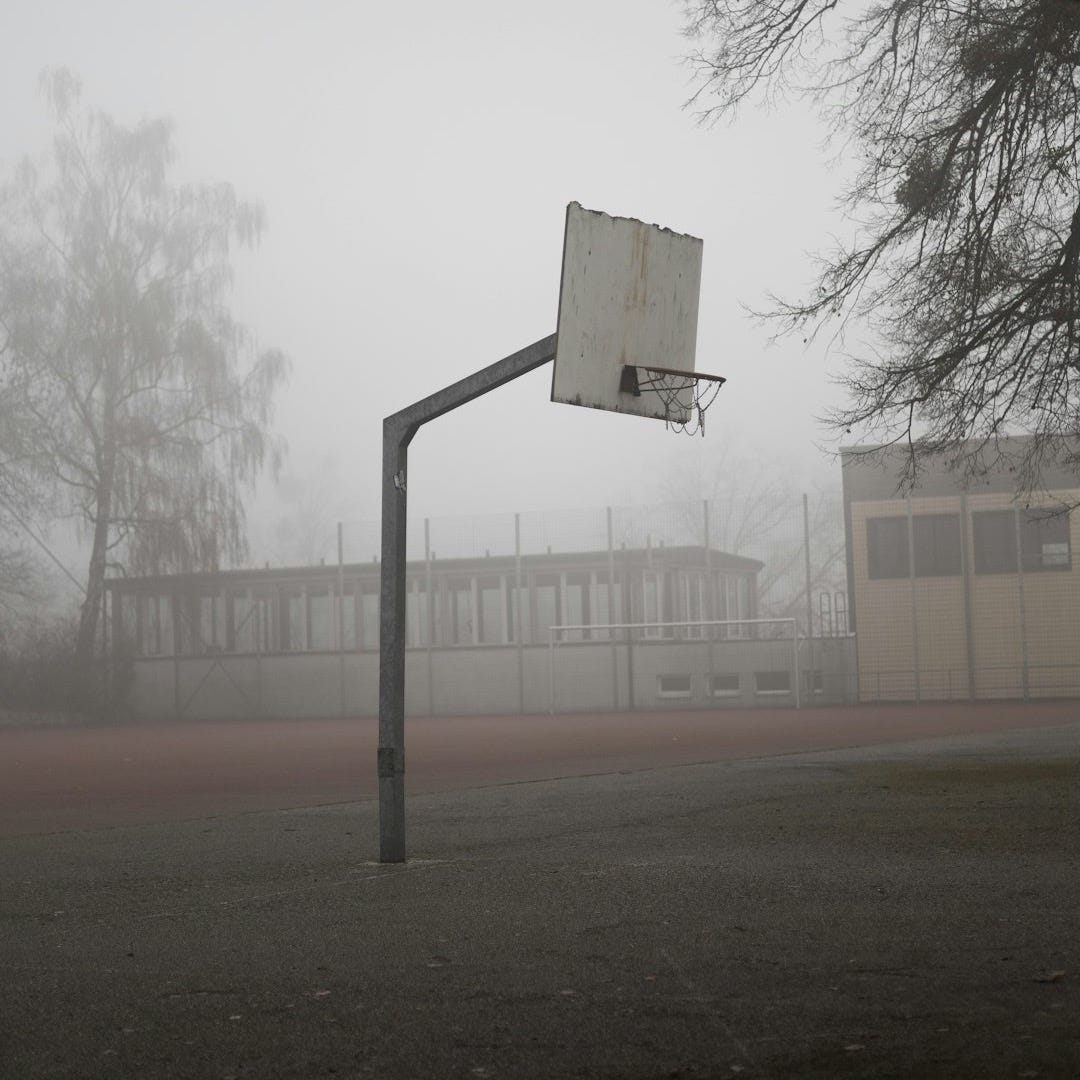
It was November, the beginning of basketball season. I had played baseball and basketball before. Baseball wasn’t an option in November; basketball was my only option.
Tryouts were over, the team was set, but they allowed me to come in for an individual tryout during practice. It was an absolute disaster. I couldn’t even do a layup. The other kids were on a completely different level. I didn’t belong in that gym, and everyone in it could see it.
I wanted to run out of the gym soon after it started. I was humiliated and embarrassed.
That feeling of being exposed in front of people you desperately need to accept you in a place where you don’t know a single person.
I didn’t make the team.
A few days later, I was sitting in the lunchroom when Jason sat down across from me. He had been at the tryouts, and he remembered me. I don’t remember what he said, I just remember feeling less alone. We became best friends. We still are to this day.
He brought me into his friend group. A completely different world from the one I had come from.
So now I had a new environment. New rules, new friends, and a new identity being constructed in real time.
And a humiliating situation that still needed answering.
I became obsessed with basketball. I played all summer, I studied the game, and went to summer camp.
I played like my life depended on it. I guess to that version of me, it did.
I made the team the next year and played through high school.
The strategy worked.
What I couldn’t see at the time was that, in those weeks and months, a belief had been installed so deeply I didn’t know it existed: Achievement is the path to acceptance.
I didn’t decide this. I didn’t choose it. I didn’t write it down and sign off on it.
It snuck in unnoticed, and then it ran my life for the next thirty years.
In every boardroom, every performance review, and every moment of comparison, it was there. Every time I felt threatened the alarm fired. Signaling a threat. A threat, that to my body felt like death. And every time, I doubled down on the next achievement that would finally make this all go away.
I had no idea any of it traced back to a gym in Indianapolis where a thirteen-year-old kid couldn’t do a layup.
That moment felt humiliating.
But what my nervous system experienced was something far more primitive than embarrassment.
It didn’t just feel the humiliation. It recognized it and automatically shifted into defense mode to protect the kid who learned early that emotional sensitivity wasn’t safe. That vulnerability got you hurt. The solution was to toughen up, achieve more, and prove you were worth keeping around.
That kid showed up in that gym.
And what happened there didn’t just embarrass him. It confirmed everything he’d already been taught to believe.
You’re not enough. And everyone can see it.
The body can’t tell the difference between physical danger and social danger because for most of human history, there wasn’t one. The same alarm fires. The same urgency floods the system.
If the tribe rejected you, it was a threat to survival.
Belonging isn’t a preference. It’s the infrastructure on which our survival is built. And the nervous system still operates as if that equation hasn’t changed, which means rejection doesn’t just feel uncomfortable. It feels like a threat to your existence.
And when it lands on top of a wound that’s already there, it doesn’t just sting, it confirms.
There’s something else the brain carries that most of us never know is there.
A default assumption.
The nervous system doesn’t treat being alone as neutral. It treats the presence of trusted others as the baseline, the expected state. Connection isn’t the bonus. It’s what the brain assumes is true before anything else.
There’s a study where people were asked to estimate how steep a hill was. Standing alone, they significantly overestimated the incline. Standing next to a close friend, the hill looked less steep. Same hill. Different nervous system state.
That’s not a metaphor. That’s the biology.
When belonging disappears, when you walk into a room where you don’t believe you belong, or feel alone inside a crowd, the brain isn’t registering a preference. It’s registering a deficit. A survival gap the nervous system immediately begins trying to close.
This is why rooms where you don’t belong are so exhausting, even when nothing dramatic is happening. Your nervous system is running a search it can’t complete. Working overtime on a social problem that registers as existential.
Long before any of us had language for any of this, the brain was already running a quieter calculation underneath everything else.
A probability check.
If I’m in distress, what are the odds someone comes?
If I reach out, what happens?
If I show who I actually am, what’s the risk?
For some people, the answer came back reliable. Safe. The baseline calcified around security.
For many of the people reading this, the answer came back conditional.
Safety was available, but only under certain conditions. Only when you were useful. Only when you perform. Only when you made people proud, didn’t need too much, stayed impressive enough to be worth keeping around.
The system filed that as the rule.
Not consciously. This happens below awareness. Before you had the ability to question it.
And that’s where the wiring begins.
I eventually found a name for this process in an NF lyric.
Insidious is blind inception.
The idea that the most harmful beliefs and habits don’t arrive with a warning. They’re planted without us realizing. And then, blindly, they begin to dictate our lives through our narratives. And create our sense of who we are.
We don’t see them come in.
We just wake up one day, living inside perceptions they built.
Not in our awareness. In the space just outside it. In the blind spots we don’t know we have because the blind spot is, by definition, the one thing we can’t see.
That’s not a coincidence.
That’s the design.
Blind inception is the process by which adaptations wire themselves into identity without conscious participation.
They don’t arrive as decisions. They accumulate through experiences.
The boundary between who you are and the identity you built to survive doesn’t disappear in a single moment. It erodes, one repetition at a time. Until the day you see a version of yourself you no longer recognize.
The gap wasn’t built consciously. It built itself around the parts of you that needed protection.
Which means the identity you’ve spent decades defending — the drive, the performance, the need to prove, the alarm that fires when someone questions your worth — you didn’t choose it.
It chose you.
Before you were old enough to have a say.
This is why the alarm that was there long before that gym, the one that had been running quietly for years, became a five-alarm fire at thirteen and can still be firing at forty-three.
I was performing at work for people who already respected me.
At the dinner table with those who already accept me.
I was working hard to prove that I mattered.
Driven by a belief, built in a gym for a thirteen-year-old kid, that achievement was my path to acceptance.
The gap between who you are and how you live isn’t always a failure of discipline.
It’s the drive to survive, to belong, still doing its job in an environment that no longer requires it.
That thirteen-year-old kid in that gym needed that strategy.
He needed something to grab onto in a room where he felt exposed and alone.
But the man sitting in boardrooms decades later didn’t.
Here’s what I want you to take from this.
The reaction isn’t the problem. The alarm isn’t the enemy. It’s protection. It was a brilliant adaptive response to the specific conditions of a specific life. It worked.
The problem is that I never saw it get installed. So I never thought to question whether the strategy that kept a fourteen-year-old afloat in a new school is still the right one for the life I was trying to build.
That’s why we must challenge our BS.
Belief Systems that quietly run the show.
Blind Spots you can’t see because blind inception put them exactly where you didn’t know you needed to look.
Bullshit Stories you’ve been telling yourself about who you are, what you’re capable of, and what you deserve. Stories that feel like truth because they predate your ability to question them.
You can’t challenge what you can’t see.
But once you become aware that the BS exists, it’s hard to keep pretending that it doesn’t.
Awareness is the beginning, not the end.
Once you see the system that built the identity, a different question arises.
If the version of you you’ve been defending was constructed to protect a sense of belonging, then who were you before construction began?
If this hit closer to home than you’d like to admit, you don’t have to navigate it alone.
I work with people who look successful on paper but know there’s a gap between who they are and who they want to be. We look at what’s actually running under the surface and build alignment from there.
If you’re ready to stop drifting and start closing that gap, send me a message.
We’ll start with a conversation and see what’s possible.
P.S. Forward this to someone who has achieved everything they were supposed to and still can't shake the feeling that it's not enough. Not to diagnose them. Just to give them a name for something they've always felt.
Great text. While we unlearn the strategy, we need to grieve the kid who needed it.
I like the built in tightness that adds a tense feeling to your words. It elicits the feeling that you went through and I enjoy hearing lived experience that differs from mine, and still arrives at the same conclusions.
Mentors and Tormentors are equal influences as far the BS we believe
(l loved that part! — but its buried at the end of your piece).
Thanks for sharing your evolution and understanding ✨